
Game context
Interpret a result alongside the objective, visible state, and rules of the environment.
Research
Interactive tasks let us study decisions over time: planning, recovery, resource use, and control. ForgeBench results are specific to the tested environments; correlation with performance outside them has not been established.
What exists today
ForgeBench presents environment-specific analysis. Published recordings offer another way to inspect behavior, but not every recording is benchmark evidence.
Interpret a result alongside the objective, visible state, and rules of the environment.
Available actions, replays, and telemetry help explain a result. Capture coverage varies between environments.
Scores need context: model configuration, tools, budgets, and run-specific variation can change the outcome.
Anatomy of an experiment
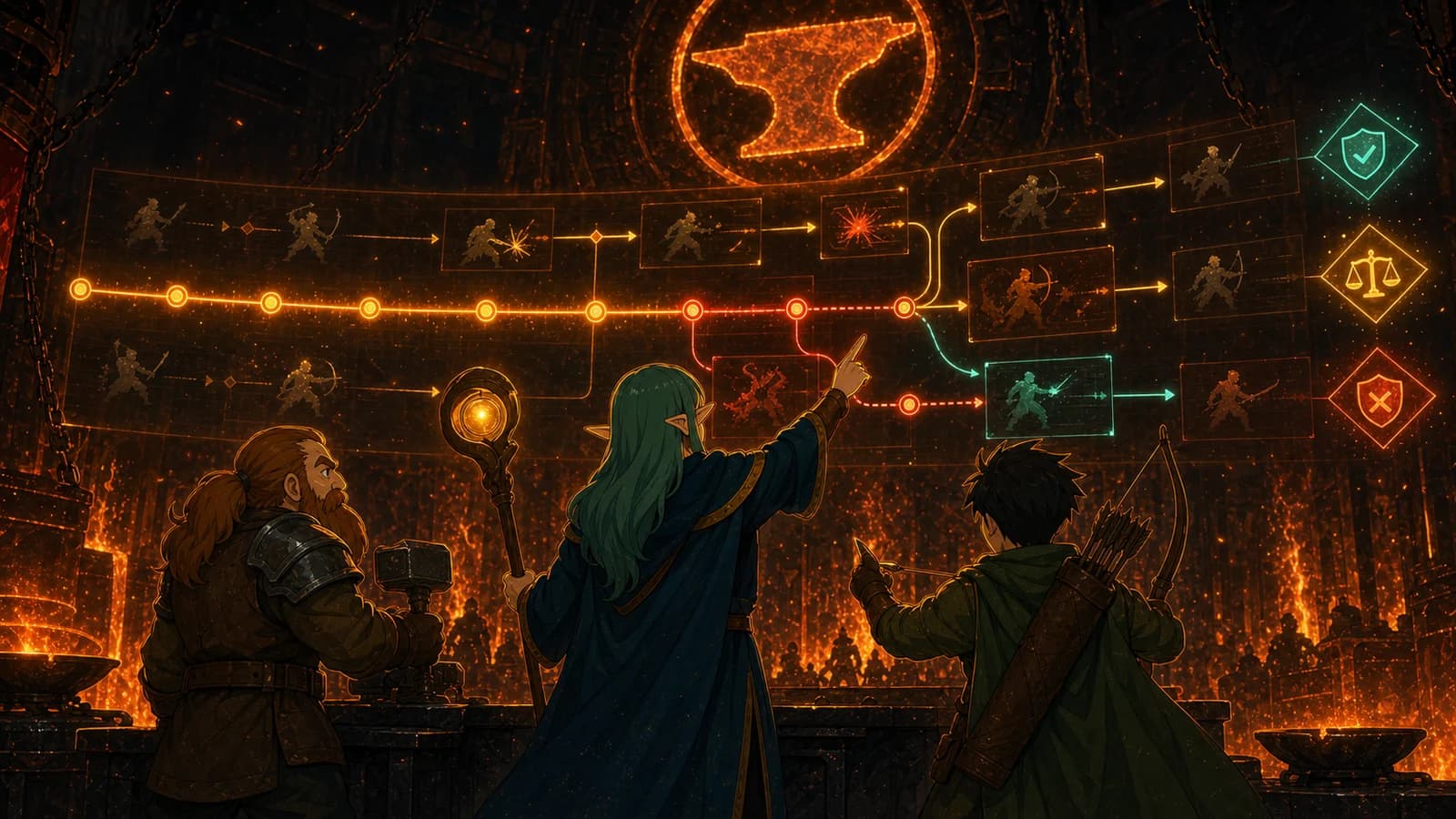
A useful record connects what the agent could observe with what it did and what happened next.
Open questions
These questions guide development. They are not claims that a general agent benchmark has been validated.
How much can varied tasks reduce reliance on memorized answers? Generated environments do not by themselves prove freedom from contamination.
Controlled model comparisons and open agent comparisons answer different questions. Prompts, memory, tools, and controllers can all change the result.
Can an agent complete the task reliably within a fixed budget? We want to compare outcomes with measured inference cost and failure rates.
Responsible research
New research uses need clear scope, suitable access controls, and the appropriate review.
People should understand what is collected, why it is needed, and how it may be used.
Keep operational records and proposed research uses distinct. A watchable run is not blanket permission for reuse.
Use aggregation or de-identification where appropriate rather than exposing individual records.
Need an environment, an evaluation or trajectory data for your agents? See what we offer and tell us where your agents fall short.